57% of German companies now use AI. Most have barely started.
For the first time, a majority of German companies use AI. What the 2026 figures say, why smaller firms are still behind, and where AI pays off first.
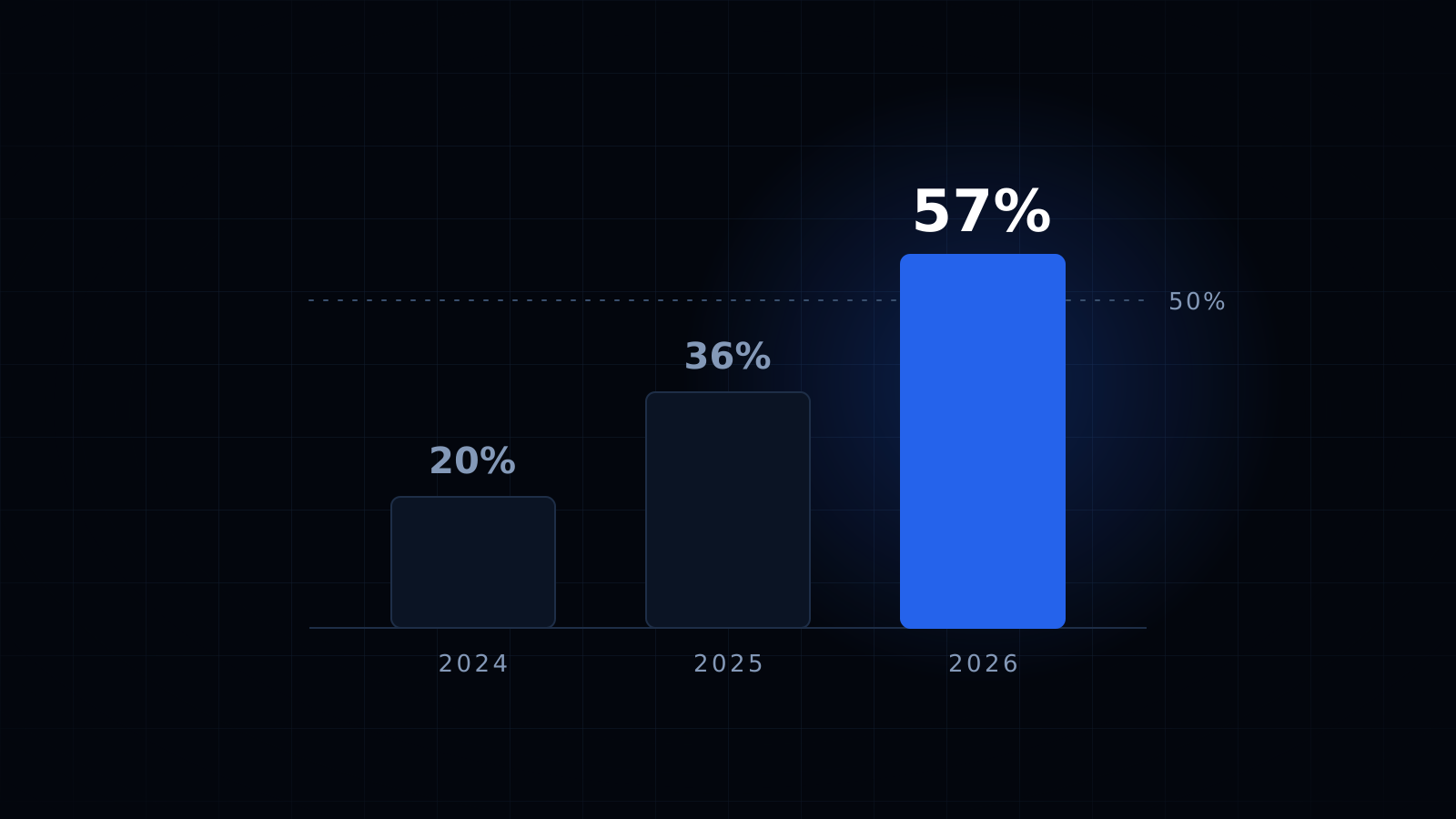
In September 2026 the industry association Bitkom reported that 57% of German companies use artificial intelligence. A year earlier it was 36%, and in 2024 it was 20%. For the first time, companies that use AI are the majority.
The same survey has a second finding that gets less attention: about nine in ten companies say they are still at the beginning.
What the numbers say
Bitkom surveyed 603 companies with at least 20 employees. Beyond the 57% that use AI, another 38% are planning or discussing it. Only 4% say AI is not relevant for them.
Among the companies that have not started, the reasons named most often are missing know-how for the technical implementation and legal uncertainty. So the obstacle is rarely a lack of interest. It is not knowing how to start, and not knowing what is allowed.
Smaller firms are a different story
The Bitkom figure leaves out companies with fewer than 20 employees, which is most companies in Germany. KfW Research looks at the whole Mittelstand, including the smallest firms. Its analysis shows that 20% of small and mid-sized companies used AI in the period from 2022 to 2024, up from 4% in 2016 to 2018. Among firms with more than 50 employees the share was 36%. Among firms with fewer than five it was 19%.
The KfW data also shows what is actually in use. Language generation (14%) and text recognition (10%) lead by a wide margin. Demanding applications such as data analytics (3%) are rare.
The two studies cover different periods and different company sizes, so the numbers cannot be compared directly. Together they show the same thing. AI use is spreading quickly, mostly as ready-made tools for writing and reading text. AI that is connected to a company's own processes and data is still the exception.
Why "we use ChatGPT" is not the finish line
An employee who drafts emails with an assistant saves a few minutes a day. That is useful, and it counts as "using AI" in a survey. But the larger gains come when AI does a defined piece of work inside a process:
- an enquiry comes in at 9 pm and gets a correct answer and a booked appointment,
- an incoming invoice is read, checked against the order and prepared for approval,
- a technician asks a question and gets the answer from 20 years of internal manuals.
These need access to your data and your systems, and someone who decides what the AI may do on its own. That is the step most companies have not taken yet.
Where AI pays off first
In four areas, a first result within weeks is realistic for small and mid-sized companies:
- Customer enquiries. Answering recurring questions and booking appointments around the clock. Our AI receptionist use case shows what this looks like.
- Documents. Reading invoices, delivery notes, applications or contracts and passing the data to the system where it belongs.
- Internal knowledge. A search that answers from your own manuals, policies and past projects, and shows the source.
- Quotes and reports. First drafts from structured data, checked by a person before they go out.
All four have clear inputs, a result you can check, and a person who stays responsible. That also keeps them in the lower risk categories of the EU AI Act.
How to start without a big project
- Pick one process. Choose one that is frequent, annoying and measurable. "Reduce time to answer enquiries" is a project. "Introduce AI" is not.
- Measure before you build. How many cases per week, how long does each take, how often does it go wrong? Without a baseline you cannot tell whether it worked.
- Run a pilot of four to six weeks. Real data, a small group of users, a clear decision at the end: expand, change or stop.
- Keep a person in the loop. Let the AI prepare and a person approve, until the numbers show where that is no longer needed.
- Clarify data protection at the start. Where is data processed, who has access, what is stored? These questions are easier to answer before the first line of code than after.
The companies in the 57% are not far ahead. Most of them have the same next step in front of them as everyone else.
Sources
Thinking about AI for your business?
Tell us what you have in mind and we'll say honestly how we'd build it.
More articles
· 4 min read
Five AI trends German businesses should plan for in 2027
AI agents, data sovereignty, smaller models, compliance by design and the e-invoicing deadline: what is likely to shape AI projects in Germany next year, and what to do about each.
Read article
· 4 min read
The EU AI Act in autumn 2026: what German SMEs need to do now
The high-risk deadline moved to December 2027, Germany has named its AI regulator, and the transparency rules already apply. A plain summary for small and mid-sized companies.
Read article